
July 17, 2025
By Adam Musa,
The Tranquility News Correspondent, North America
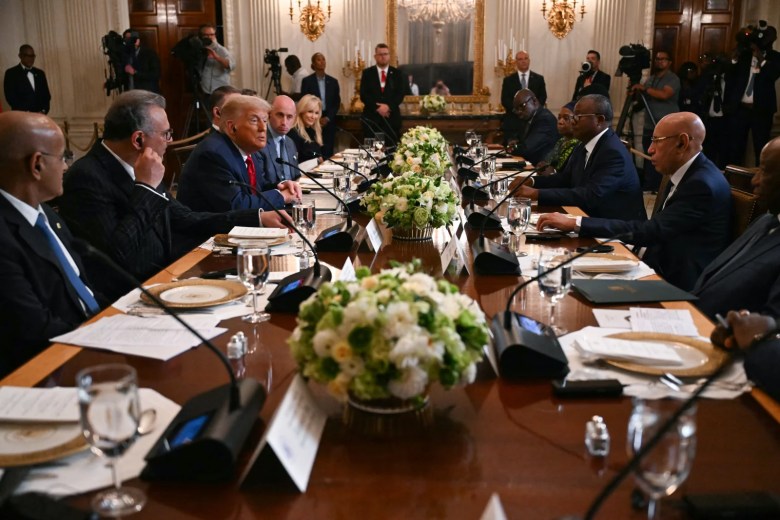
When President Trump walked into the Oval Office in July 2025 to meet leaders from Gabon, Guinea-Bissau, Liberia, Mauritania, and Senegal, he didn’t mince words: “We’re shifting from aid to trade.”
It wasn’t just a soundbite — it was a signal. Trump’s second-term strategy is clear: less charity, more commerce. The goal? To open new economic frontiers in Africa while scaling back traditional aid programs long criticized as inefficient.
But behind this bold vision lies a complex reality: a sweeping domestic law — the One Big Beautiful Act (OBBA)— that will reshape U.S.-Africa ties in ways that go far beyond trade deals.
The OBBA highlights Big Promises and Big Gaps
Signed on July 4, 2025, the OBBA is a legislative behemoth. Officially known as H.R. 1, it bundles policies on taxation, border security, immigration, and domestic benefits. While it never mentions Africa by name, its ripple effects across the continent will be hard to ignore.
What’s in the Act?
- Ends the de minimis import privilege for goods under $800 (effective 2027), meaning small African exports will now face tariffs.
- Adds a 5% tax on outbound remittances starting in 2026, hitting African households that rely on diaspora funds.
- Pumps $55 billion into border security and detention facilities, while introducing steep new immigration fees.
The law’s economic angle is wrapped in Trump’s signature “America First” philosophy: cut aid, create deals, and protect U.S. industries. Yet critics warn it leaves a policy vacuum on how to engage Africa’s diverse economies—where data gaps, political instability, and China’s dominance make the playing field anything but level.
What African Leaders Brought to the Table
Jim Watson/AFP via Getty Images
During that July 2025 meeting, five African leaders didn’t come empty-handed. Each offered tailored investment proposals to lure U.S. dollars and deepen ties.
| Country | Leader | Key Proposals |
| Gabon | Brice Oligui Nguema | Mineral partnerships (rare earths, manganese, uranium, oil), with local processing to build value chains. Announced U.S. funding for Banio Potash Mine. |
| Guinea-Bissau | Umaro Sissoco Embaló | Opened doors to investment in phosphate, bauxite, and oil sectors. |
| Liberia | Joseph Boakai | Aimed for $3 billion in U.S. investments in uranium, lithium, cobalt, gold, diamonds, rubber, and timber. |
| Senegal | Bassirou Diomaye Faye | Proposed a “Tech City” in Dakar with Atlantic views, plus tourism projects (golf courses) and offshore energy exploration. |
| Mauritania | — | Discussed minerals (iron ore, copper, gold), but focused more on migration and diplomacy. |
Clearly, the pitch was ambitious: Africa wants U.S. capital, tech, and infrastructure. The question is whether Trump’s model — transactional, security-driven, and immigration-restrictive — aligns with that vision.
Immigration Crackdown: Africa Feels the Heat
OBBA’s immigration overhaul isn’t just a U.S. border issue—it’s a foreign policy flashpoint.
Why it matters for Africa
Countries like Sudan, Somalia, and Cameroon have thousands of citizens relying on U.S. asylum and TPS protections due to conflict. Now, steep fees and tougher eligibility could slam those doors shut.
According to the NPR, the OBBA allocates:
- $45 billion to expand ICE detention capacity
- $10 billion for state-level border infrastructure
- New fees: asylum ($100), TPS ($500), no waivers
- Benefit restrictions to citizens, Lawful Permanent Residents (LPS), and select entrants (e.g., Cuban/Haitian).
Human Rights Watch warns these measures may: Curtail legal migration and asylum pathways for conflict-affected nationals; lead to return-and-reintegration challenges for African governments; spark diplomatic tensions. For instance, Nigeria has already warned that it won’t take back deportees, setting the stage for more diplomatic spats.
Taxation of Remittances
For many African families, remittances are lifelines — totaling over $50 billion a year, dwarfing foreign aid in nations like Nigeria and Egypt. The ODI Global think tank projects this tax could:
- Cuts disposable income in African households.
- May push migrants toward informal transfer systems.
- Generates under $5 billion annually for the U.S.— a drop in the bucket, with huge costs for Africa.
African stakeholders fear it undermines the U.S.’s image as an economic partner, possibly redirecting flows toward Europe. As one analyst put it: “This isn’t just a tax — it’s a penalty on poverty.”
Winners and Losers
Ending the $800 de minimis rule will hit African exporters of textiles, crafts, and small agricultural goods, who depend on low-cost access to U.S. markets. Meanwhile, changes to U.S. sugar quotas could upset trade for countries like South Africa and Mauritius.
Africa is not a monolith; its economic power is concentrated in the hands of a few countries. Here’s the leaderboard:
Top 10 African Economies (2025)
| Rank | Country | GDP (US$ Billion) |
| 1 | South Africa | 410.3 |
| 2 | Egypt | 347.3 |
| 3 | Algeria | 268.9 |
| 4 | Nigeria | 188.3 |
| 5 | Morocco | 165.8 |
| 6 | Kenya | 131.7 |
| 7 | Ethiopia | 117.5 |
| 8 | Angola | 113.3 |
| 9 | Côte d’Ivoire | 94.5 |
| 10 | Ghana | 88.3 |
(Top African Economies by GDP)
The China Factor: Washington’s Elephant in the Room
While Trump talks trade, China acts. It’s been Africa’s largest trading partner since 2009, with:
- $295.6 billion in trade in 2024
- Projected $322 billion in 2025
- Tariff-free access for 98% of goods from 21 African nations
Beijing’s strategy is clear and aggressive: infrastructure, energy, and minerals, backed by policies to eliminate African trade deficits by 2035. In contrast, U.S. engagement feels piecemeal and punitive, hampered by migration crackdowns and remittance taxes.
Trump’s Africa play is bold—but fraught. OBBA’s domestic-first tilt, risks alienating partners who crave investment, not barriers. Meanwhile, China keeps cementing its dominance, offering roads, rails, and raw cash where Washington offers tariffs and taxes.
If the U.S. wants to compete in Africa, it needs more than slogans. It needs a coherent economic strategy that marries security with opportunity, trade with trust—and that’s a race Trump can’t afford to lose.
Recommended Posts


Adam is an accomplished professional with a unique interdisciplinary background: combining expertise in psychology, journalism, and restorative justice. He has a bachelor’s degree in community psychology from Makerere University Kampala, Uganda; a master’s degree in journalism from Northeastern University in the United States; and a master’s degree in restorative justice from Vermont Law & Graduate School in the United States. As a versatile communicator and advocate of social justice, Adam brings a unique perspective to his work. He is capable of fostering understanding, insight, clarity, and a commitment to meaningful change.
Email contact: adam@tranquilitynews.com


