
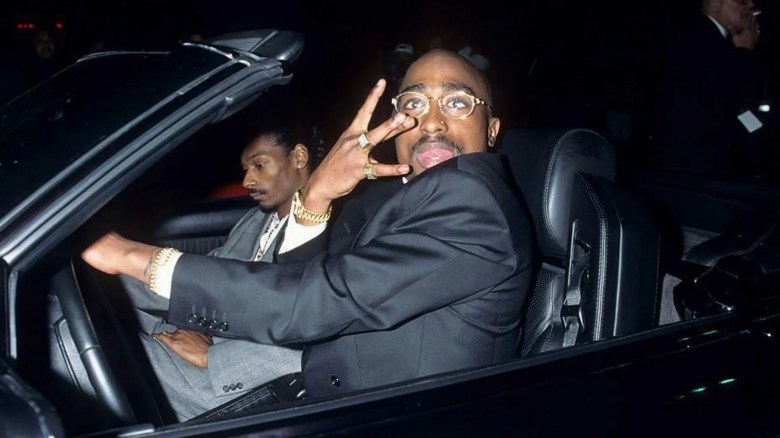
2pac Shakur: The ghost in the speakers
On music, memory, and the justice system’s bargain with unreliable storytellers
August 19, 2026
By Adam Musa
The Tranquility News Correspondent, North America
Boston, Massachusetts
Long before the courtroom, before the indictments and the carefully parsed proffers, Tupac Shakur lived in the speakers outside the music shops of Mbale. In the late 1990s and into the 2000s, shop owners in Eastern Uganda wheeled their loudspeakers onto the sidewalk and flooded the dusty air with American hip-hop: 2Pac, Coolio, Snoop, Xzibit, cut with local hits. The music arrived like contraband from another planet: restless, defiant, larger than the ordinary rules of life.
My friends and I slipped into the daytime discos at the then Elgonia (club Oasis), those slightly safer gatherings of high-school leavers and boarding-school escapees from Manjasi, Bukedi College, Nabumali. Later, during Senior Six vacation, the same soundtrack followed me to Kampala’s DV8 and the Rooftop. By the time I reached Mitchell Hall at Makerere University Kampala (MUK) in 2002, room F28 was rarely quiet. A large CD player kept 2Pac’s voice almost constant. He remains my greatest of all time. That ranking has never changed.
I’m just a die-hard 2Pac fan. Everything that follows is written from that loyalty, not from any claim to legal expertise. Don’t shoot the messenger. Shoot the message if you must.
Now, three decades after the drive-by that killed him on a Las Vegas street, the man prosecutors say orchestrated the shooting sits in a Nevada courtroom. Duane “Keffe D” Davis, once a South Side Compton Crips figure, is on trial for murder. The case against him does not rest primarily on forensic miracles or long-buried witnesses. It rests on a quieter, more corrosive transaction at the heart of American criminal justice: the state’s willingness to purchase a criminal’s story with immunity, then later reclaim the version of that story the criminal chooses to sell.
In 2008, Davis sat with investigators under a formal proffer agreement. What he said about Shakur’s killing could not be used against him. Nearly a decade later he co-authored Compton Street Legend and gave interviews that placed him at the center of the crime: supplying the gun, riding in the Cadillac, directing the retaliation for an earlier casino beating of his nephew. Those public admissions, not the original protected statements, became the foundation of the prosecution. A prosecutor has conceded, with unusual candor, that without the book Davis would “probably” never have been charged.
The defense answers that the book was a commercial performance, its authorship blurred, its claims unreliable. Davis himself has since insisted he was not even in Las Vegas that night, directly contradicting the narrative he once sold for profit and notoriety. Prosecutors, for their part, promise to separate fact from embellishment, as if thirty years of silence, self-mythology, and strategic confession could still yield a clean distinction.
What remains is a system that first buys a criminal’s account with the promise of safety, then prosecutes him with the version he later elects to market. The arrangement rewards both performance and betrayal. It does not reliably produce justice. It produces cases that rest on the shifting word of the very people the state once agreed not to believe.
The Davis prosecution is only the latest illustration of an old problem American courts have never fully resolved: the double-edged nature of informants. They can be useful. They also introduce corrosive risks, especially when the state later relies on public statements that sit uncomfortably close to the protected disclosures it once immunized.
For anyone who cares about the architecture of probable cause and the reliability of evidence, the episode forces a return to first principles. In Aguilar v. Texas (1964), the Supreme Court insisted that an affidavit based on an informant’s tip must disclose enough of the underlying circumstances for a neutral magistrate, not a police officer or an unidentified tipster, to assess both the informant’s basis of knowledge and his credibility. Spinelli v. United States (1969) refined the test, allowing independent corroboration to salvage a deficient tip, but only if that corroboration itself met rigorous standards.
The “veracity” prong functioned as a substitute for the traditional trustworthiness of the oath. Professional informants, often embedded in the criminal worlds they reported on and motivated by payment, revenge, or self-preservation, faced strict scrutiny. Citizen-informants, presumed to act from civic duty, enjoyed a lighter presumption.
Later cases, Illinois v. Gates (1983) and Navarette v. California (2014), moved toward a more flexible “totality of the circumstances” approach, yet the core anxiety remained. An informant who cannot be held accountable for falsehoods, or whose information rests on bare conclusions rather than observed facts, is a precarious foundation for official action.
In the Davis case these long-standing concerns reappear in modern dress. The state first granted immunity for statements made under proffer. Years later it seeks conviction on the strength of a book and interviews that track those earlier disclosures. The defense challenges reliability and authorship; the defendant himself now repudiates key parts of the public account. The result is a prosecution that rests, in significant measure, on the mutable word of a man the state once promised not to use against himself.
Whether that bargain ultimately serves justice is the question the trial is testing. But I keep returning to something simpler.
On weekends, day or night, my friends and I would gather in Mitchell Hall or slip out into Kampala’s restless streets. We played “Do for Love,” “Dear Mama,” and, when the adrenaline/dopamine was up, “Hit ’Em Up” until the speakers strained. Outside, matatus roared past, laughter rose from the courtyards, and the city hummed with its own unfinished business. Inside, 2Pac’s voice was steady, uncompromising, almost paternal. We were youths, far from home, certain of almost nothing except that the music meant more than the rules that tried to contain it.
That certainty has never left me. Watching this trial from the Northeast, I feel the same stubborn loyalty and the same unease. The system that claims to speak for the dead is trading in the living’s self-mythologies, buying silence one year and selling it the next. I cannot pretend that arrangement feels like justice. It feels like another kind of performance, one that leaves the music still playing while the truth keeps changing hands
Recommended Posts


Adam is an accomplished professional with a unique interdisciplinary background: combining expertise in psychology, journalism, and restorative justice. He has a bachelor’s degree in community psychology from Makerere University Kampala, Uganda; a master’s degree in journalism from Northeastern University in the United States; and a master’s degree in restorative justice from Vermont Law & Graduate School in the United States. As a versatile communicator and advocate of social justice, Adam brings a unique perspective to his work. He is capable of fostering understanding, insight, clarity, and a commitment to meaningful change.
Email contact: adam@tranquilitynews.com


