
Twiga Minerals Vision: How Tanzania builds homegrown mining economy through skills, innovation, local content
A partnership between the Government of Tanzania and Barrick Mining Corporation is redefining local content by preparing citizens to participate across the mining value chain
FRIDAY July 31, 2026

By Patty Magubira
The Tranquillity News Reporter, Tanzania
For decades, Africa’s mineral wealth has often been measured by what leaves the ground—gold, copper, diamonds, and other resources shipped to global markets.
But Tanzania is pursuing a different ambition: Ensuring the value generated by mining remains within the economy through skilled workers, competitive local businesses, technology, innovation, and a new generation of mining professionals.
At the centre of this transformation is Twiga Minerals, the pioneering partnership between the Government of Tanzania and Barrick Mining Corporation, which is helping to redefine what local content means in one of Africa’s fastest-growing mining markets.
The vision goes beyond increasing the number of Tanzanian suppliers serving mines.
It is focused on preparing Tanzanians to participate throughout the mining value chain—from exploration and geology to engineering, mineral processing, technology, research, management and specialised services.
The initiative has gained national support as Tanzania seeks to position mining as a major driver of economic growth and industrial development.
Mining’s new role in Tanzania’s economy
Opening the Fifth Mining Local Content Implementation and Participation Forum in Mwanza, Tanzania’s Minister for Minerals Anthony Mavunde said the mining sector had grown into one of the country’s most important economic pillars.
He said the sector contributed 1.4 trillion Tanzanian Shillings in non-tax government revenue by the end of June, while its contribution to gross domestic product had reached 10.1 per cent.

“Up to the end of June this year, the sector contributed 1.4 trillion Shillings to the government through non-tax revenue. This is a major transformation that we have achieved as a nation,” Mavunde said.
Beyond government revenue, the minister said the mining industry had created a significant market for local businesses, with annual procurement of goods and services reaching 5.1 trillion Shillings.
He said the sector had generated 20,421 formal jobs, of which 16,695 were held by Tanzanians.
According to Mavunde, these achievements have been driven by reforms in Tanzania’s mining laws, policies and regulations aimed at increasing citizen participation in mining activities, services and supply chains.
The government’s next objective is even more ambitious: Turning Tanzania into a regional hub for mining goods and services in sub-Saharan Africa.
“It is important to unite and work together in producing and supplying goods and services for the mining sector. I want Tanzania to become a centre for mining products and services in sub-Saharan Africa,” Mavunde said.
He added that an expected opening of 13 new mines would create additional opportunities for employment, suppliers, and entrepreneurs.
The minister said Tanzania aimed at ensuring 90 per cent of goods and services used in mining operations were produced or provided by Tanzanians through implementation of the local content policy.
We want to ensure that opportunities created by the growth of the mining sector benefit citizens and local businesses. This requires Tanzanians to prepare themselves to take advantage of these opportunities,” Tanzania’s Minister for Minerals Anthony Mavunde.
“We want to ensure that opportunities created by the growth of the mining sector benefit citizens and local businesses. This requires Tanzanians to prepare themselves to take advantage of these opportunities,” he said.
Twiga Minerals: Turning local content into capability
The challenge facing Tanzania is no longer only attracting mining investment.
The bigger question is whether citizens have the skills and expertise required to capture the highest-value opportunities created by the industry.
That is where Twiga Minerals’ approach stands out.
Through the partnership between Barrick and the Tanzanian government, the company has focused on developing the human capital required to sustain a modern mining economy.
The partnership recognises that local participation cannot be limited to employment opportunities and supplier contracts.
A globally competitive mining sector requires Tanzanian engineers designing mining systems, geologists leading exploration programmes, technology specialists managing digital operations, researchers developing solutions, and entrepreneurs building competitive supply chains.
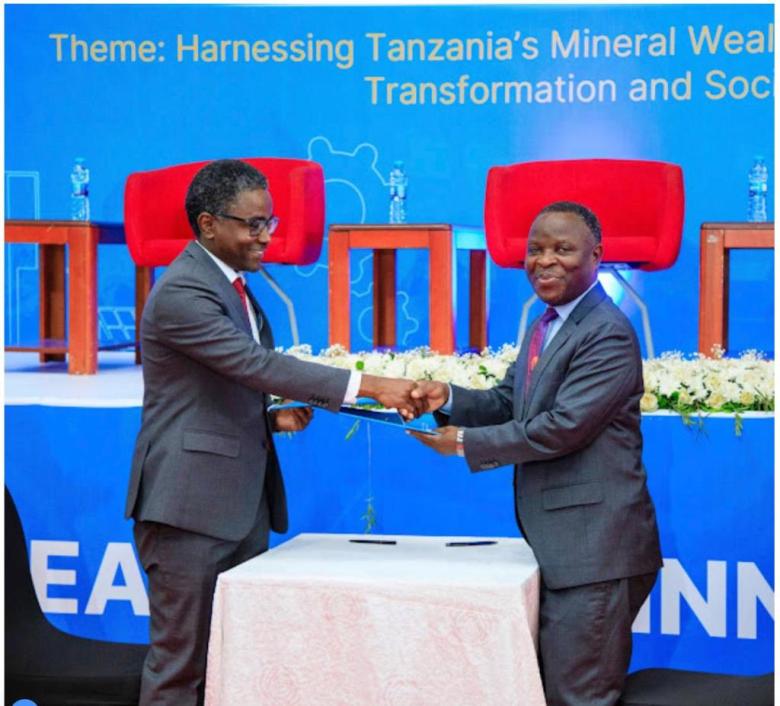
Investing in Tanzania’s mining talent
Barrick has increasingly invested in partnerships with Tanzanian educational institutions to build a pipeline of skilled professionals.
Through collaboration with the University of Dar es Salaam and other institutions, the company is supporting research, innovation, training, and practical exposure for students pursuing mining-related careers.
The programmes are designed to bridge the gap between classroom learning and real mining operations by providing students with access to industry expertise and practical experience.
Barrick has also supported scholarships for Tanzanian students pursuing mining-related studies and created opportunities for university and technical college students to undertake industrial training at its North Mara and Bulyanhulu mines.
Industry leaders say such initiatives are essential because the future mining workforce must be prepared for an industry increasingly shaped by automation, artificial intelligence, advanced exploration technologies, and the global energy transition.
The energy transition and the race for skills
The global shift toward clean energy is creating unprecedented demand for minerals required in renewable technologies, electric vehicles, batteries, and advanced manufacturing.
For mineral-rich countries like Tanzania, this presents a historic opportunity.
However, experts warn that countries will only capture the full economic benefits of the energy transition if they develop the skills needed to participate beyond extraction.
Mining is no longer only about digging minerals from the ground. It is a complex industry driven by science, technology and specialised knowledge,” Professor Elisante Mshiu, Head of the School of Mines and Geosciences at the University of Dar es Salaam.
Professor Elisante Mshiu, Head of the School of Mines and Geosciences at the University of Dar es Salaam, said modern mining requires expertise across multiple disciplines.
He said the industry needs professionals in geology, mining engineering, mineral processing, information technology, business, law, logistics, and environmental management.
“Mining is no longer only about digging minerals from the ground. It is a complex industry driven by science, technology and specialised knowledge,” he said.
From policy to practical participation
Barrick officials say Tanzania has moved from discussing local content policies to implementing them through partnerships and capacity building.
During the panel discussion, Enock Otieno, Head of Supply Chain at Barrick North Mara, said the focus now must be on practical implementation.
“We have moved from consultations. We are now in the stage of implementing local content in practice. We need to see Tanzanians participating fully in the mining economy,” he said.
He added that local suppliers must continue improving quality, adopting technology, and strengthening their ability to compete with international companies.
Building a mining legacy for future generations
The success of Tanzania’s mining ambitions will ultimately depend on whether economic growth is matched by human development.

The country’s mineral resources provide the foundation, but skilled Tanzanians will determine how much value is created from them.
The Twiga Minerals partnership represents a broader shift in the relationship between mining companies and host countries—moving from extraction alone toward shared prosperity.
As Tanzania prepares for the next phase of mining growth, its greatest investment may not be another mine.
It may be the engineers, scientists, entrepreneurs, and leaders who will build the future of the industry.
Through its partnership with the Government of Tanzania, Twiga Minerals is helping to create that future—one where Tanzanians are not only participants in mining, but architects of its success.
Recommended Posts


The Tranquility News Reporter/Sub Editor, Tanzania
Patty Magubira is an experienced environmental and business editor whose career started at the Tanzania's state-owned newspaper - The Daily News. He is a man of perfection. Aided by his extensive training as a community forestry expert before joining Tanzania School of Journalism. Magubira had successfully held various key posts in newsrooms, giving him an unmatched connections in media fraternity. Having worked as a bureau chief in Arusha and Mwanza, he managed to build a team work, boosting sales to the highest level ever. He was then promoted to a sub-editor after completing a training in Nairobi, Kenya. His incredible experience, critical thinking and exposure are critical to the quality of any media outlet.


