
The Martin Luther King Jr. I keep meeting again
Nonviolence is disciplined confrontation, not nostalgia — and it demands more than speeches and rituals
January 26, 2026
By Adam Musa
The Tranquility News Correspondent, North America
Boston, Massachusetts
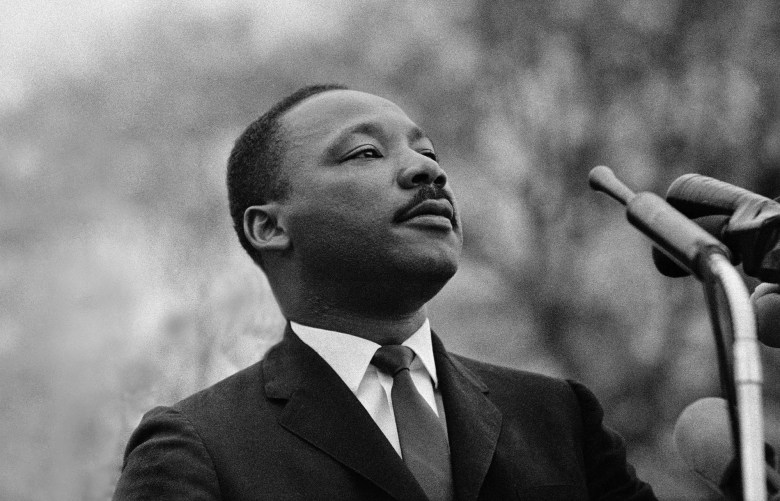
Every January, Martin Luther King Jr. returns as a civic ritual: a few familiar quotes, a softened sermon, a black-and-white photo. We praise him in the language of national comfort — unity, harmony, dreams — until he becomes less a man than a monument.
But on Jan. 19, 2026, King came back to me differently. Not as nostalgia. Not as ceremony. As a question.
What does it mean to honor a man whose politics were built on refusing the world as it is? And what does it say about us that we keep quoting his most soothing lines while stepping carefully around his most disruptive ideas?
For me, that tension isn’t abstract. It’s personal, political and deeply Pan-African.
King’s influence is regularly described as “profound.” But words like that can blur the truth. King wasn’t simply a preacher of peace. He was an architect of pressure. His insistence on nonviolent resistance was not the gentler option; it was the strategic one. His “beloved community” was not a sentimental wish. It was a radical demand that society reorganize itself around dignity.
We remember King as the voice of a moral ideal. We forget he was also a technician of social change.
Nonviolence, as King practiced it, was not passive endurance. It was disciplined confrontation. Boycotts, marches, sit-ins and civil disobedience were not symbolic gestures. They were instruments meant to expose injustice and force a response from those in power.
That was the genius of nonviolence: It could be morally disarming and politically destabilizing at the same time. It pulled conflict into public view. It made contradictions impossible to hide. It demanded a choice.
That is also why it keeps being borrowed.
In recent years, protests against police brutality and racial injustice have surged, and the shape of resistance has often looked familiar: bodies in the street, chants turning grief into public argument, and a refusal to accept that suffering is simply the price of living. The slogans change. The technology changes. The footage is now instant. But the moral mechanism still resembles King’s method: bring suffering out of hiding and make it impossible to pretend you didn’t see it.
The common misunderstanding is that nonviolence means the absence of conflict. King understood it as the disciplined management of conflict — a way to fight fiercely without becoming murderous. It was not retreat. It was a decision to confront without surrendering one’s humanity.
That clarity matters because our age loves false choices. It tells the oppressed they must be either quiet or chaotic, either grateful or dangerous, either polite or dismissed. King offered a third category: loud without cruelty, forceful without dehumanization, uncompromising without becoming what you oppose.
And yet this is precisely where King is most often rewritten.
American culture celebrates King’s “dream” while ignoring his diagnosis. It praises his language of harmony while muting his insistence on structural change. He becomes a national lullaby — a quote to soothe rather than a critique to sharpen.
But King’s later work is the part of his story that most resembles the world we live in now.
Near the end of his life, King identified what he called the “triple evils”: racism, poverty and militarism. He was no longer speaking only about segregated lunch counters. He was speaking about a moral architecture — how societies decide who is disposable, how inequality reproduces itself, how war drains both budgets and conscience, and how a nation can claim justice while financing violence.
He wasn’t becoming more pessimistic. He was becoming more accurate.
King saw that the struggle could not be contained. Racism was not merely personal prejudice; it was a system. Poverty was not merely a lack of money; it was a political decision. Militarism was not merely foreign policy; it was a set of priorities that turned social hope into collateral damage. These forces were not separate problems. They were connected engines, feeding one another.
That is why King’s legacy is easy to praise and difficult to inherit. To inherit King is not simply to admire him. It is to accept the burden of his logic.
And his logic travels.
King is usually treated as an American story, but his imagination refused to stay within borders. His language became increasingly global because he understood the moment he lived in: the world was becoming interconnected, and injustice was learning to travel.
His idea of a “World House” was not a poetic aside. It was an argument that the modern world had become too small for any people to pursue freedom in isolation.
This is where King meets Pan-Africanism.

The African independence movements of the mid-20th century were not separate from the U.S. civil-rights struggle. They were part of the same global surge against hierarchy and domination. When King traveled to Ghana in 1957 for its independence celebrations, he was not making a sentimental pilgrimage. He was witnessing what the oppressed look like when they stop requesting permission.
Ghana did not simply raise a new flag. It announced that an old order — colonial rule — could fall.
For King, the meaning was immediate. If empire could be defeated abroad, then segregation could not be treated as inevitable at home. Ghana was proof that the world could change, and that the oppressed could force it to do so.
Freedom, King learned again, is never given. It is organized.
Pan-Africanism has always understood that truth, often at brutal cost. Kwame Nkrumah’s dream of African unity carried a warning: political independence without economic control can become a refined form of bondage. Patrice Lumumba’s assassination exposed how quickly foreign interests — and internal betrayals — can crush sovereignty.
The continent’s liberation history is full of victories that arrived with warning labels. A new anthem does not guarantee a new life. A new president does not guarantee a new future. The struggle continues after the speeches end.
That is why King’s “triple evils” still resonate beyond the United States. A nation can abolish legal segregation and preserve inequality through economics. A country can win independence and still lose control of its resources. A society can hold elections and still feed on the poor. The vocabulary changes — neo-colonialism, structural adjustment, extractive capitalism, police states — but the moral question remains the same: who has power, who pays for it, and who is expected to endure.
For me, that isn’t theory. It’s memory.
I first met Pan-Africanism the way you sometimes meet an idea that changes your life: not in a classroom, not in a book, but in a conversation, you didn’t know you were ready for.

In 2002, fresh out of high school, I met Professor Dani Wadada Nabudere at his Marcus Garvey Pan-African Institute in Mbale, Uganda. One of his nephews — a close friend of mine — introduced me. I had admired Nabudere from a distance: his scholarship, his activism, his refusal to reduce African liberation to polite reforms. Even as a teenager, I recognized a form of intellectual courage in him — the insistence that Africa must free itself not only politically, but mentally.
At the time, I supported the Uganda People’s Congress (UPC), drawn to the language of independence-era nationalism — the belief that politics could still be a tool for dignity. When I greeted Nabudere, I mentioned that former Chief Justice George Masika had mentored me. Nabudere’s reaction surprised me. He lit up and asked, with real curiosity, how a teenager came to be guided by a figure like that.
So, I told him.
In 1994, I was a schoolboy helping put up campaign posters around town when Justice Masika ran for the Constitutional Assembly in Mbale Municipality, and later for the 1996 parliamentary elections. It was a politically intense season, when power didn’t merely compete — it pushed. The NRA/NRM machine was building dominance across eastern Uganda, and politics was not a calm exchange of ideas. It was identity, pressure and survival.
Masika was not just an admired name. Our family house was next to his, separated only by the Bank of Baroda branch. His nephew Patrick — my childhood friend — was my bridge into that world. Through Patrick, history didn’t feel distant. It lived on the next doorstep.
That afternoon, Nabudere spoke with the ease of someone who had seen too much: about global liberation movements, about post-independence hopes and disappointments, and about how power protects itself. He spoke about how ideals get swallowed by ambition — and how liberation must be defended even after it is declared.
But what stayed with me most was simpler.
He took me seriously.
Nabudere didn’t shrink the world to spare my youth. He expanded it. And in that expansion, I began to see that King, Nkrumah, Lumumba and Nabudere belonged to the same moral lineage: people who refused to accept injustice as the price of existing.
That afternoon did not give me certainty. It gave me direction.
Which is why MLK Day, years later, still unsettles me. Not because it invites celebration, but because it invites accounting.
The danger now is not that King will be forgotten. The danger is that he will be domesticated — turned into a harmless saint, his radicalism edited out, his critique trimmed to fit comfortably into speeches, his moral discomfort replaced with easy admiration.
We will praise him without practicing the kind of pressure he believed in. We will remember him without inheriting his demands.
But if King has anything to teach this moment, it is that symbolic victories cannot substitute for structural change. He would not ask whether we can quote him. He would ask what kind of lives people are living underneath the quotations.
And the question returns each year, sharper than the last: Are we building a beloved community — or merely rehearsing its language?
The answer will not arrive on its own.
It must be organized.
Recommended Posts


Adam is an accomplished professional with a unique interdisciplinary background: combining expertise in psychology, journalism, and restorative justice. He has a bachelor’s degree in community psychology from Makerere University Kampala, Uganda; a master’s degree in journalism from Northeastern University in the United States; and a master’s degree in restorative justice from Vermont Law & Graduate School in the United States. As a versatile communicator and advocate of social justice, Adam brings a unique perspective to his work. He is capable of fostering understanding, insight, clarity, and a commitment to meaningful change.
Email contact: adam@tranquilitynews.com


