
How two Malawians took their sovereign State to African Court and won
The Pan-African bench ruled that Malawi’s judicial authorities had violated the basic fair trial rights of its citizens.
FRIDAY September 25, 2026

By The Tranquillity News Reporter, Tanzania
In the cool, elevated city of Arusha, Tanzania, the African Court on Human and Peoples’ Rights delivered a stern rebuke to the Republic of Malawi on September 24, 2026.
Rendering a rare judgment in default, the Pan-African bench ruled that Malawi’s judicial authorities had violated the basic fair trial rights of two of its citizens through broken procedural quorums and illegible court records.
The ruling marks the end of a long, arduous legal battle waged by Kambeyo Ka-Kaunda, a former Blantyre property consultant, and Emmie Chenda Mkandawire, a retired primary school teacher.
The saga began 16 years ago in 2010. Ka-Kaunda and Mkandawire had assisted a business associate Profera Mtambalika in obtaining the legal title for a parcel of land known as Title number Ndirande 26 in Blantyre.
In exchange for their services, Mtambalika was contractually bound to transfer a 2.2-hectare portion of the property to them.
When Mtambalika defaulted on the deal, Ka-Kaunda and Mkandawire filed a lawsuit in the High Court of Malawi on April 20, 2010, seeking a contractual remedy.

What followed was a nightmare of domestic litigation.
The High Court dismissed the suit on June 9, 2014, holding that the underlying contracts were invalid due to misrepresentation.
Bizarrely, the ruling was handed down despite Mtambalika and his counsel failing to appear during the hearings.
The Malawi Supreme Court of Appeal (MSCA) affirmed the dismissal with costs in the first appeal on August 2, 2016.
Despite written pleas to the Chief Justice, the Applicants were never provided with a signed, formal copy of the appellate ruling.
Seeking extraordinary relief, the duo applied for a review. The MSCA again dismissed their case on April 6, 2022.

When the Applicants requested an official copy of the review judgment, the court registry handed them illegible, handwritten notes.
Furthermore, the review hearing had been conducted by just two judges—violating the Malawian constitutional requirement of an odd-numbered bench of at least three, as well as Practice Directions calling for a seven-judge panel.
After an application to restore the matter to the cause list sat unanswered for six months, Ka-Kaunda and Mkandawire turned to the international stage, filing Application No. 004/2022 before the African Court on Human and Peoples’ Rights.
As the case reached the African Court, time was running out.
Facing severe health issues, Ka-Kaunda, alongside Mkandawire, applied for an expedited procedure and a judgment in default on January 27, 2026.
Despite being formally served with the proceedings as far back as August 2024 and granted multiple extensions, the Republic of Malawi repeatedly failed to file a response or participate in the proceedings.
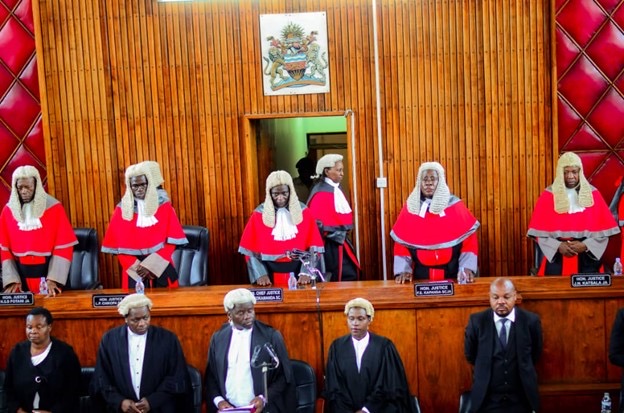
Exercising its powers under Rule 63(1) of its Rules, the African Court proceeded to issue a default judgment against the sovereign state.
While the African Court vindicated the Applicants’ procedural rights, it drew a firm line on the underlying land claim.
Writing for the African Court, the bench clarified that the right to property under Article 14 of the Charter protects established legal entitlements.
Because Malawian domestic courts had determined the original contract was invalid due to misrepresentation, no vested property right existed for the African Court to enforce.
Presuming moral prejudice from procedural violations, the African Court ordered Malawi to pay MK 500 ($ to each Applicant.
The applicants’ claims on behalf of their family members were dismissed due to lack of official documentation such as birth or marriage certificates.

Malawi must immediately furnish Ka-Kaunda and Mkandawire with official, legible copies of both the August 2016 judgment and the April 2022 review decision.
Within three months, the judiciary must publish both judgments on the official websites of the Judiciary and the Ministry of Justice, keeping them accessible for at least one year.
The State was ordered to overhaul its court record management and ensure clear adherence to judicial quorums and practice directions.
Malawi must submit an implementation report within six months. Failure to comply will trigger an open implementation hearing.
The judgment was not entirely unanimous. Judge Rafaâ Ben Achour issued a Partial Dissenting Opinion, disagreeing with the majority’s refusal to find a violation regarding trial delays.
Judge Ben Achour argued that a cumulative delay of nearly 10 years for a straightforward land dispute inherently violated the right to be tried within a reasonable time under Article 7(1)(d) of the Charter.


