
Authoritarianism Without Borders
How autocrats are turning technology, law, and diplomacy into weapons against dissidents worldwide
September 4, 2025
By Adam Musa,
The Tranquility News Correspondent, North America
New York — On a summer evening in Brooklyn, New York, journalist Masih Alinejad spotted a car idling outside her home. She was used to harassment—anonymous calls, online abuse, strangers at her door. But this time felt different.
“They were watching me,” she told the BBC.
Weeks later, U.S. prosecutors revealed the men in the car were working with Iranian intelligence. Their mission: kidnap Alinejad, smuggle her onto a speedboat, and deliver her to Tehran.
She narrowly escaped. But Alinejad was never the exception. She was part of a global pattern: transnational repression — is when authoritarian states hunt and silence critics even after they flee abroad.
An Old Practice, Supercharged
Political assassinations abroad are not new. Soviet agents once stalked defectors in Europe. Latin American juntas tracked opponents overseas.
What is new is the scale and sophistication?
“Authoritarians don’t stop at their borders anymore,” says Sarah Lehmkuehler of the UK’s Foreign Policy Centre. “If people find their voice in exile, regimes find ways to silence them.”
And it’s not just global powers. In 2024, Ugandan opposition leader Kizza Besigye was abducted in Nairobi and returned to Kampala to face death-penalty charges. Months earlier, 36 of his supporters were kidnapped in Kenya. Once a refuge, exile now offers no protection.
The Digital Dragnet
Technology has made repression faster, cheaper, and harder to escape.
Before journalist Jamal Khashoggi was murdered in Istanbul, Saudi operatives had already infiltrated the private lives of exiles. In Canada, activist Omar Abdulaziz discovered his phone was infected with Pegasus spyware.
“They had everything—my contacts, my messages, my movements,” he recalled.
Today, assassins and kidnappers are only one weapon in the arsenal. Regimes deploy malware, spyware, troll armies, and smear campaigns. These digital tools—sold and traded across borders — enable governments from China to Rwanda to monitor and intimidate critics anywhere.
“Rather than weakening authoritarianism, globalization has strengthened it,” notes sociologist Dana Moss.
For dissidents like Alinejad, the threat is unrelenting. “Every time I touch my phone, I wonder if they’re listening,” she has said.
The Bureaucratic Trap
When surveillance isn’t enough, regimes weaponize the law.

Interpol’s “Red Notice” system, intended to track fugitives, has been repeatedly abused to pursue political opponents. Charges dressed up as counterterrorism are now common. Some regimes even hire private investigators to harass exiles through blackmail and deception.
In 2019, Paul Rusesabagina, the hero of Hotel Rwanda, was lured to Dubai and abducted to Kigali under a politically motivated notice — a case the Council of Europe later condemned as an abuse of international law.
Turkey has targeted Gülenists this way. Russia has pursued exiled journalists and activists. The result: opponents strangled not with handcuffs but with paperwork — unable to travel, open bank accounts, or secure residency.
Democracies’ Blind Spot
Western democracies have been slow to recognize the scale of the threat. In the U.S., the FBI admits many cases are misclassified as “routine harassment,” overlooking the foreign government connection.
Worse, democratic governments often enable repression — selling spyware, overlooking abductions, or prioritizing arms deals over human rights.
Some remedies are emerging. Representative Adam Schiff’s H.R. 3654 would criminalize stalking or harassing exiles on behalf of foreign governments. The EU has debated similar measures. But few democracies are willing to risk crises with partners like Saudi Arabia, Rwanda, or Uganda.
The New Authoritarian Playbook

Across cases, the pattern is striking silence critics at home; if they flee, chase them abroad — through spyware, abductions, Red Notices, or threats to family.
The toll is devastating:
- Alinejad lives under FBI protection.
- Abdulaziz saw his private life exposed.
- Rusesabagina spent years in prison before release.
- Besigye now faces a military court.
If exiles can be snatched from foreign streets, if spyware penetrates phones worldwide, if international policing is hijacked — then asylum itself begins to collapse.
A Growing Global Threat
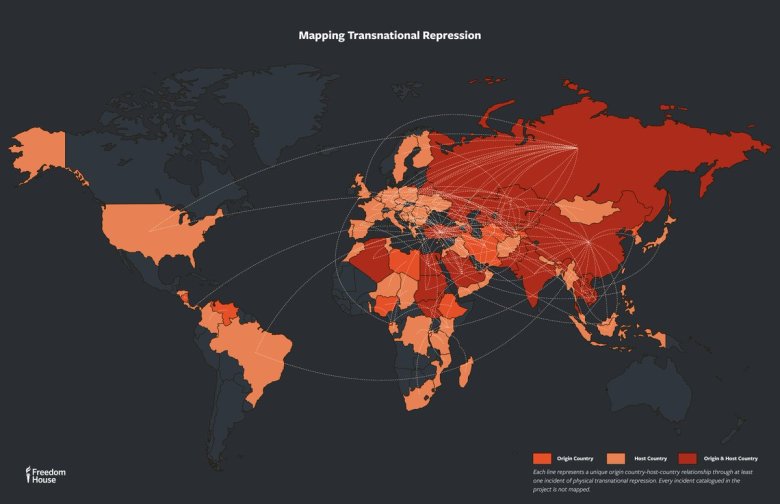
By 2025, the crisis has only escalated. Freedom House counts 1,219 incidents of transnational repression across 103 countries.
New perpetrators include Cuba, El Salvador, Myanmar, Sierra Leone, and Yemen. The worst offenders remain China, Turkey, Egypt, Russia, and Tajikistan, with Cambodia rising fast.
High-profile cases show how normalized the tactic has become:
- Uganda’s mass rendition of 36 activists in Kenya (2024).
- China’s harassment of Uyghur and Hong Kong activists abroad.
- Russia’s forced returns of antiwar dissidents.
International awareness is catching up. The UN issued its first brief on transnational repression in 2025. The G7 condemned it and launched a Digital Detection Academy. The U.S. and UK are drafting stronger laws. But enforcement remains uneven, and perpetrators still act with impunity.
The Price of Dissent
Khashoggi’s murder made headlines. Alinejad’s kidnappers faced charges. Abdulaziz’s spyware case sparked outrage.
But most victims remain nameless — students, NGO workers, ordinary activists whose stories never reach the news.
They live in shadows, stripped of the certainty exile once promised.
“Exile used to mean escape,” Lehmkuehler reflects. “Now, it just means you’re a little farther away.”
For Alinejad, the car outside her Brooklyn home was a chilling reminder that safety is fragile — even on the streets of New York. For thousands of others, it’s a daily reality.
This is authoritarianism in the 21st century: borderless, networked, relentless. If democracies fail to protect exiles, the very idea of refuge will vanish—taking with it the promise of safety beyond borders.
Recommended Posts


Adam is an accomplished professional with a unique interdisciplinary background: combining expertise in psychology, journalism, and restorative justice. He has a bachelor’s degree in community psychology from Makerere University Kampala, Uganda; a master’s degree in journalism from Northeastern University in the United States; and a master’s degree in restorative justice from Vermont Law & Graduate School in the United States. As a versatile communicator and advocate of social justice, Adam brings a unique perspective to his work. He is capable of fostering understanding, insight, clarity, and a commitment to meaningful change.
Email contact: adam@tranquilitynews.com


