
Uganda’s haunting echoes of a past we never expected to relive!
The stories elders told weren’t exaggerations — and today’s Uganda risks normalizing the very patterns we once swore never again
March 1, 2026
By Elvis Kintu Nsonyi
New York City
Growing up, I listened to several community elders recount the misanthropic excesses of Idi Amin. Their stories sounded almost apocalyptic that in youthful skepticism, I dismissed some of them as mere exaggerations. A part of me even regretted that I would never witness such a chapter of history firsthand, if only to separate myth from fact.
Then, in primary six, our school administration decided to screen a film about Amin. I was extremely elated. This was my moment to see history dramatized before my eyes. I watched without blinking. Even when the film was paused during an intimate scene on rated guidance due to our age, I remained transfixed. By the end of it, whatever doubt I had harbored dissolved. I admit that I detested Amin more profoundly than before.
Around that same period, the north of Uganda was hemorrhaging under the brutal insurgency of the Lord’s Resistance Army (LRA) led by Joseph Kony. Political commentators would often draw provocative parallels between Kony’s terror and the state under Yoweri Museveni. But for the people of northern Uganda, these were not abstract debates. They endured displacement, mutilation, abduction and death. The trauma was neither cinematic nor exaggerated.
I vividly recall how Alokolum National Major Seminarians were compelled to relocate to “Soweto” at Bukalasa Minor Seminary because of the insecurity. Even sacred spaces were not spared the tremors of the northern war.
The names of Archbishop Janan Luwum, Chief Justice Benedicto Kiwanuka and Msgr. Victor Mukasa remain etched in Uganda’s moral memory martyrs of a state that devoured its own. Their deaths were once invoked as solemn reminders of how low a nation could sink!
And yet, as the old adage goes, even a dead clock is right twice a day. I begrudgingly acknowledged Amin’s fierce rhetoric against corruption and his infrastructural ambitions. It was a paradox I still wrestle with. How tyranny could coexist with occasional gestures toward national development!
Today, however, the more unsettling paradox is that many of the crimes that shaped our collective abhorrence of Amin seem to echo in contemporary Uganda. Reports and allegations of extrajudicial killings, the alleged poisoning of outspoken politicians, the incarceration of opposition figures and the narrowing of civic space among others have cultivated an atmosphere thick with fear.
We often find ourselves linguistically impoverished in attempting to define embezzlement, corruption and the misappropriation of public resources. Words such as embezzlement and misconduct sound almost administrative, yet what they conceal is a deliberate betrayal of public trust. There is a calculated siphoning of hope from the very citizens whose taxes sustain the state.
Corruption is not merely a legal infraction, it is an erosion of institutional integrity. Embezzlement is not simply the unlawful diversion of funds, it is the theft of classrooms yet to be built, hospitals yet to be equipped and roads yet to be paved. Misappropriation of public resources is not an accounting anomaly, it is a silent assault on the social contract.
Perhaps our difficulty in finding the right diction lies in the magnitude of the offenses. Language struggles to contain the weight of stolen futures, deferred development and betrayed generations. What we confront is not just financial impropriety, but a moral collapse disguised in bureaucratic terminologies.
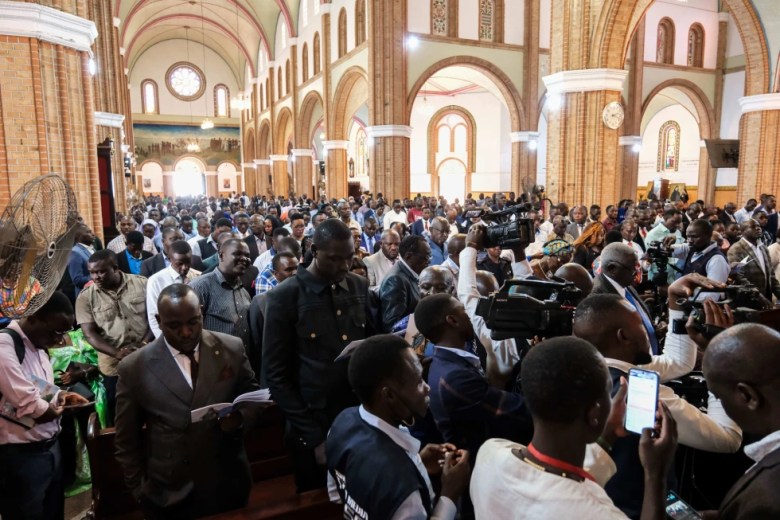
All in all, if a Mass gathering for figures like Dr. Kizza Besigye is blocked, one cannot help but ask, when did worship become subversive? When did intercession become insurrection?
It is in such moments that I believe Uganda’s national motto; “For God and My Country” feels less like a declaration and more like an aspiration deferred.
If faith is policed and patriotism criminalized, what remains of the covenant between citizen and state?
History has an unnerving patience, it waits, it watches and sometimes, it returns disguised as progress.
But nations too have clocks. And however long the night, the hands will eventually align with dawn. Whatever slogan we may temporarily wear, the resilient spirit of Ugandans endures. And someday, as history has shown elsewhere, the citizens shall overcome.


