
TAHA tailored BUS grants transform lives of youth, women entrepreneurs
Appealing business blueprints with action plans in the entrepreneurship training programme earn them seed money.
SUNDAY September 21, 2025
By Patty Magubira
The Tranquility News Reporter, Tanzania
TAHA has over the past five years empowered 50,000 youth and women entrepreneurs from both Tanzania Mainland and Zanzibar, with a tailored training programme nurturing innovative minds.
At least 5,000 trainees with outstanding business pitches received grants throughout the period to overcome start-up challenges; including access to machinery they needed for kickstarting their ventures, said TAHA Chief Programmes Manager, Mr Simon Mlay.
“For those who could not manage to receive the grants in the five cohorts, the training programme linked them up with financial institutions for loan opportunities and market access support,” Mr Mlay said.
Dubbed BUS (Bäuerliche Unternehmer Schulungen), the agribusiness training programme has been gathering its alumni community each year to share success stories, tackle challenges, and pave the way forward together.
The Coordinator of the BUS entrepreneurship training Alex Allen said the programme had been transforming lives by helping the youth and women in horticulture to become self-reliant economically.
Every year, we witness new ideas and increased awareness driving them to train, write business blueprints, and seize growth opportunities,” Coordinator of the BUS Entrepreneurship Training Programme Alex Allen.
“Every year, we witness new ideas and increased awareness driving them to train, write business blueprints, and seize growth opportunities,” he explained.
BUS
Smallholder farmers countrywide tend to focus primarily on self-sufficiency and adjusting their traditional practices, often considering market-oriented actions, individual positioning, or meaningful collaborations as luxury.
The participatory, systematic, country and needs specific BUS approach is training farmers to consider local circumstances optimally to secure lasting effects.
Consequently, awakened farmers recognise their strengths, skills and opportunities for their personal development and conditions.
Once aroused, the farmers consider future and market oriented views to production, products, and value, and set the course for the actual market demand.

They finally develop clear concepts with action plans for themselves and their businesses, BUS entrepreneurship Master Trainer Kassim Abdullah Kassim said.
Undeniably, the transformative programme is designed to open doors for youth and women to discover diverse capital sources to grow their businesses.
Unlike traditional entrepreneurship approaches, BUS is three pronged, with its first module providing trainees seeking to innovate beyond conventional methods in their entrepreneurial journeys with practical learning and self-discovery.
Diving into BUS II, Abdullah Kassim said, enabled trainees to master business analysis and market creation, hence making it the most difficult module to some participants, as, at some point, it requires them to be conversant with basic mathematics.
“BUS III is all about perfecting the trainees’ business planning acumen,” said Abdullah Kassim, explaining that although TAHA targeted farmers and livestock keepers, everyone needed the BUS course to succeed in life, as it encouraged self-confidence, setting free the entrepreneur within the participant.
I wrote the idea every year, but I did not win. I continued improving it, and this year, I have succeeded to convince the judges,” Issa Shamte Omar, a banana farmer from Pemba, Zanzibar.
As a result of the BUS entrepreneurship training programme, Issa Shamte Omar, a youthful banana farmer from Pemba, for instance, saw the opportunity for producing Bokashi – fermented compost obtained from natural ingredients.
Bokashi improves soil structure and organic matter, soil life, and plant nutrition, among others, and increases crops yield.
Owing to lack of shelter during rain seasons, Shamte Omar, however, could neither produce the organic fertilizer throughout the year nor store it to meet the market demand.
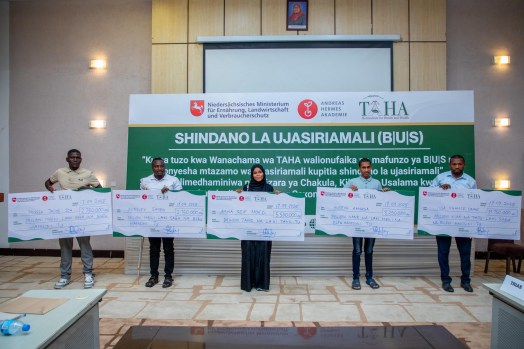
The Bokashi concept coupled with a concrete action plan he developed for the business idea he pitched during the last cohort of the BUS entrepreneurship training programme fetched him Sh13,750,000 (about $5,570) seed money he needed the most.
“I wrote the idea every year, but I did not win. I continued improving it, and this year, I have succeeded to convince the judges,” said Shamte Omar, advising his fellow participants in the 2025 cohort to keep on knocking.

At the end of the BUS entrepreneurship training, participants in each cohort are required to present business ideas that are creative enough to resolve various challenges the society faces.
Four runners-up in this year’s business pitching contest with their prizes in brackets were Hussein Ahmada Sh8,250,000 (about $ 3,340), Amina Seif Moha’d Sh5,500,000 (about $2,230), Wisely Salim Sh2,750,000 ( about $1,115), and Mussa Jacob Sh2,750,000 about $1,115).
Besides TAHA, many other institutions and players with expert guidance and market connections are involved in this journey of unlocking the youthful male and female farmers’ potential.
“This makes the programme of transforming the young farmers’ entrepreneurial dreams into reality become even more expensive,” Allen hinted.
The players include development partners, mostly Andreas Hermes Akademie (AHA) through its BUS entrepreneurship programme modules, and the Ministry of Agriculture and Food Security of Saxony – a federal state in southeastern Germany.
We want to see farmers become number one market researchers, systematically investigating the market needs daily,” Ms Bahati Ntweve from Agricultural Section of Arusha City Council.
Others are financial institutions, specifically commercial banks, and public institutions, particularly the Tanzania Investment and Special Economic Zones Authority (TISEZA), formerly Tanzania Investment Centre (TIC).
Also engaged in the programme are ministries of Agriculture and the Ministry of State in the President’s Office responsible for Regional Government and Local Authorities.
All these stakeholders are important in the programme, as they complement various needs of the participants, including of capital and licensing issues.
“This training is intensive, we teach cohorts of not more than 20 trainees each in a bid to understand entrepreneurial concepts and practice deeply,” Allen said.
He explained that the players had helped TAHA to train about 37 trainers of trainers, 29 of them from Zanzibar and eight from Arusha, Kilimanjaro, and Manyara regions, who are transferring the key knowledge to participants in this programme.
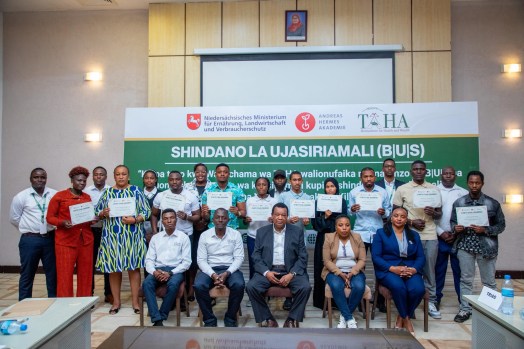
“Keep up your commitment and creativity,” Dr Edmond Matafu, the TAHA Board Member, commended this year’s trainees, admitting that he never expected to witness fresh business and technology ideas they presented.
“It is the beginning for the winners to improve their businesses in a bid to secure opportunities that can take them to the next level. Those who lost should learn their mistakes to further improve their business ideas,” said Dr Matafu as he extended the TAHA gratitude to AHA and all other players involved in the programme.
Veronica Mrema, TISEZA Zonal Manager and one of the judges in the business pitching contest, said the training programme was in line with the Tanzania government’s policy that aimed at, among other things, adding value to crops.
Bahati Ntweve from Agricultural Section of Arusha City Council cautioned the trainees, nevertheless, over the presence of cutthroat competition in the market, advising them to always look for something unique if their products are to sustain.
“We want to see farmers become number one market researchers, systematically investigating the market needs daily,” she stressedΩ
Recommended Posts


The Tranquility News Reporter/Sub Editor, Tanzania
Patty Magubira is an experienced environmental and business editor whose career started at the Tanzania's state-owned newspaper - The Daily News. He is a man of perfection. Aided by his extensive training as a community forestry expert before joining Tanzania School of Journalism. Magubira had successfully held various key posts in newsrooms, giving him an unmatched connections in media fraternity. Having worked as a bureau chief in Arusha and Mwanza, he managed to build a team work, boosting sales to the highest level ever. He was then promoted to a sub-editor after completing a training in Nairobi, Kenya. His incredible experience, critical thinking and exposure are critical to the quality of any media outlet.


