
June 10, 2026
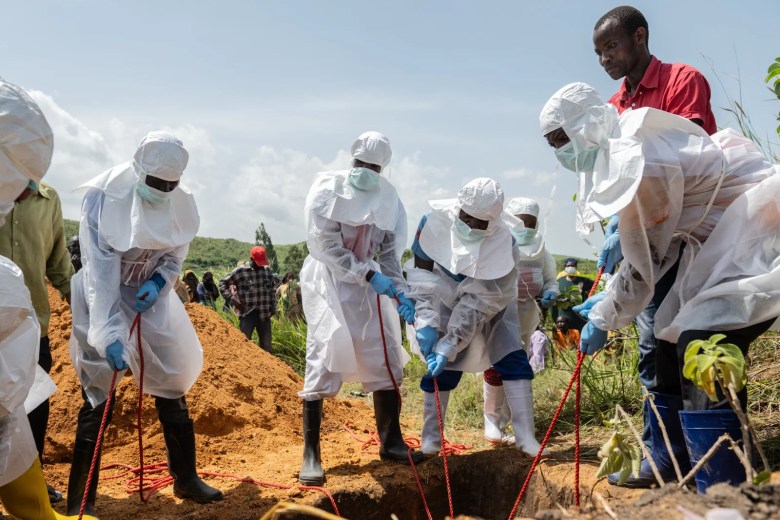
Moses Sawasawa/AP
By Adam Musa
The Tranquility News Correspondent, North America
Boston, Massachusetts
In eastern Democratic Republic of the Congo, Ebola is doing what viruses do. It is moving from body to body through blood, vomit, sweat, touch, burial, care. But the outbreak is also moving through something less visible and harder to contain: suspicion.
The rare Bundibugyo strain has put health workers in a brutal race against time. Unlike the better-known Ebola virus strain, this form has no approved vaccine or specific treatment. Supportive care can save lives, but prevention remains the first line of defense. That means isolation, contact tracing, protective equipment, laboratory testing, and safe burial practices.
On paper, the logic is simple. In practice, it is anything but.
Families resist the removal of bodies. Patients flee treatment centers. Rumors spread that Ebola is invented, imported, or profitable for outsiders. Health workers are threatened. Clinics become targets. The very measures designed to stop transmission can become evidence, in the minds of frightened communities, that something sinister is underway.
It is tempting to call this ignorance. That would be a mistake.
The real crisis is not that communities lack information. It is that information arrives without trust.
This is where cultural history has something urgent to teach public health. In the late 20th century, historian Lynn Hunt helped define what became known as “the new cultural history.” Its central insight was deceptively simple: people do not merely respond to material conditions. They interpret them. They live inside systems of symbols, rituals, stories, obligations, and inherited meanings. Culture is not ornament. It is the architecture of social life.
Hunt pointed to historians such as E. P. Thompson and Natalie Zemon Davis because they took ordinary people seriously as interpreters of their own world. Thompson’s famous account of the eighteenth-century English crowd showed that food rioters were not simply hungry mobs. They acted from what he called a “moral economy,” a shared belief that certain forms of market behavior violated communal justice. Their actions were illegal, but they were not irrational. They were rooted in a collective sense of what society owed its members.
Davis made a related argument about religious violence. Crowds, even in moments of brutality, acted through symbols and rituals that carried meaning. Violence was not merely an eruption of chaos. It could mark boundaries, defend sacred values, and express a community’s understanding of order.
That same lesson applies, uncomfortably but powerfully, to Ebola.
When a family demands the body of a loved one, it may be violating public health protocol. But it may also be defending a moral universe in which the dead must be washed, mourned, touched, accompanied, and honored. When a community rejects an isolation center, it may be endangering itself. But it may also be responding to a history in which outside authorities have too often arrived with force, extraction, promises, or neglect.
In other words, resistance is not always the opposite of reason. Sometimes it is reason shaped by history.
Eastern Congo is not an empty stage on which a disease has suddenly appeared. It is a region marked by armed conflict, displacement, weak state authority, foreign intervention, and repeated humanitarian emergencies. People who have lived through violence and abandonment do not automatically believe that the next uniformed official, foreign expert, or emergency worker has come only to help. Distrust is not a rumor. It is a memory.
That does not make misinformation harmless. Rumors about Ebola can kill. They can delay treatment, drive infected people underground, and turn health workers into targets. But rumors rarely succeed on their own. They need soil. In eastern Congo, that soil is made of grief, insecurity, political failure, and the old suspicion that powerful institutions do not tell the whole truth.
Public health officials often speak as if the problem is communication: Get the right facts to the right people in the right language. But the Ebola crisis shows that communication is too thin a word. What is needed is engagement.
Communication says: Here is what you must do.
Engagement asks: What do you fear? Whom do you trust? What would make this intervention feel less like a violation and more like protection?
This distinction can determine whether an outbreak slows or spreads. A laboratory can confirm a case, but it cannot persuade a family to report symptoms early. A treatment center can provide care, but it cannot function if patients believe entering it means disappearing. A burial team can prevent transmission, but not if mourners see its work as desecration.
This is why “safe and dignified burial” may be one of the most important phrases in outbreak response. It recognizes that the dead are not just infectious bodies. They are mothers, brothers, children, elders, neighbors. They belong to families whose grief has cultural form. The task is not to abolish mourning but to make mourning survivable.
The best public health work in such a crisis does not treat culture as a problem to be solved. It treats culture as the ground on which any solution must stand.
Local radio hosts, religious leaders, neighborhood volunteers, and trusted health workers are not accessories to the “real” medical response. They are part of it. They translate science into social trust. They make room for questions that official briefings often flatten. They carry messages through networks that existed before the emergency and will remain after it.
This is not a sentimental argument. It is a practical one. Trust is infrastructure. Without it, contact tracing collapses. Isolation fails. Burial protocols are rejected. Health workers are attacked. The virus wins.
The lesson from Hunt, Thompson, and Davis is that people act from within worlds of meaning. A community’s refusal may be dangerous, but it is rarely meaningless. To understand that is not to romanticize resistance or excuse violence against health workers. It is to recognize that coercion has limits, especially in places where authority is already suspect.
Ebola control requires science. It requires protective gear, surveillance, treatment centers, trained staff, and money. But science cannot simply descend on a community and expect obedience. It must become legitimate.
Legitimacy is built in small acts: allowing families to see that their loved ones are being cared for; involving religious leaders in burial adaptations; using local media to answer rumors before they harden into belief; treating fear not as stupidity but as evidence of a broken relationship.
The tragedy of Ebola is that intimacy becomes dangerous. The gestures by which people love one another — nursing the sick, washing the dead, gathering in grief — become routes of transmission. Any response that ignores the emotional and cultural weight of those gestures will fail to understand the outbreak it is trying to stop.
The virus may begin with biology. But whether it spreads depends on society.
In eastern Congo, the fight against Ebola is therefore a fight over trust: who has it, who lost it, who can rebuild it, and whether it can be restored quickly enough to save lives. The world may be watching case counts. Communities are watching something else: whether the people asking them to change their most sacred practices are doing so with honesty, humility, and care.
Epidemics begin in communities, and they end there too. The question is whether public health authorities can remember that before the virus teaches the lesson again.
Recommended Posts


Adam is an accomplished professional with a unique interdisciplinary background: combining expertise in psychology, journalism, and restorative justice. He has a bachelor’s degree in community psychology from Makerere University Kampala, Uganda; a master’s degree in journalism from Northeastern University in the United States; and a master’s degree in restorative justice from Vermont Law & Graduate School in the United States. As a versatile communicator and advocate of social justice, Adam brings a unique perspective to his work. He is capable of fostering understanding, insight, clarity, and a commitment to meaningful change.
Email contact: adam@tranquilitynews.com


